Custom Storefront Windows for NYC Landmark Commercial Buildings — LPC-Approved Systems

Limited-time 10% discount
on your first project

Trusted local window experts serving you since 2008
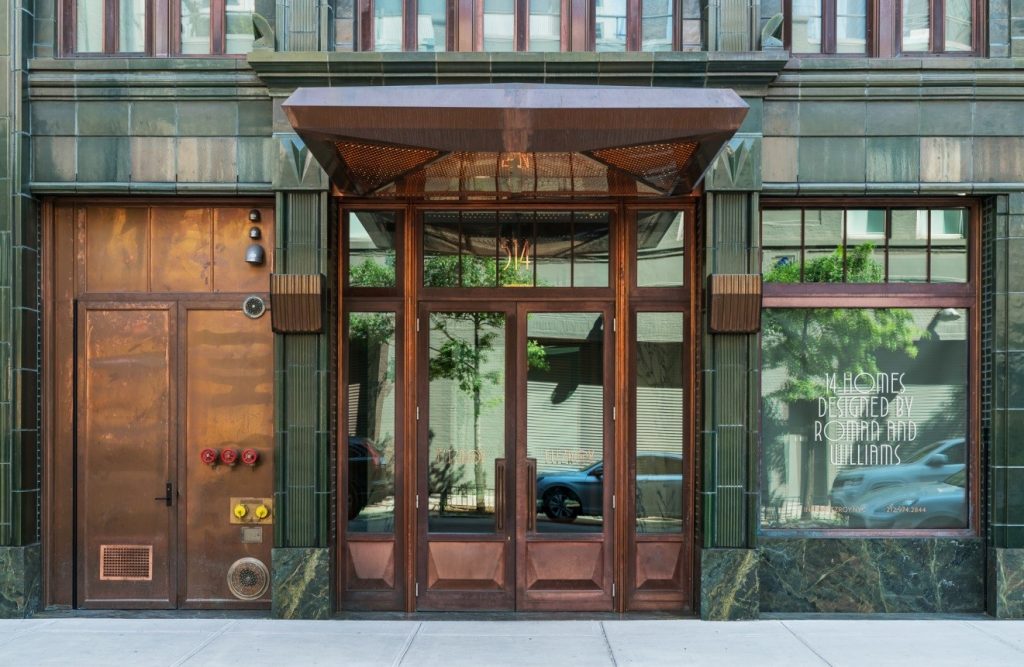
Replacing or restoring windows and storefronts in a New York City landmark commercial building — in SoHo, Greenwich Village, Tribeca, or any other historic district — requires systems that match the building's original facade proportions, materials, and profile geometry, and documentation that satisfies the Landmarks Preservation Commission's review requirements. Open AWD supplies custom steel, aluminum, and bronze storefront systems for historic commercial buildings across NYC, and prepares the full technical documentation required for LPC submissions.
- SoHo Cast Iron, Greenwich Village, Tribeca — completed projects
- Steel · Aluminum · Bronze — historic commercial profiles
- LPC shop drawings and documentation prepared as standart
- Serving NYC commercial clients since 2008

Limited-time 10% discount
on your first project

Trusted local window experts serving you since 2008

What Makes Historic Commercial Storefronts Different

A commercial storefront in a New York City historic district is not simply a large window. It is an architectural element with specific proportions — the relationship between the transom, the display window, the bulkhead, the pilasters, and the entrance door — that defines the visual character of the building at street level and is protected by the LPC's designation of the district.
In SoHo's Cast Iron Historic District, storefronts are particularly regulated: the LPC's guidelines specify acceptable materials, profile geometries, glass types, and the preservation or replication of original cast iron elements. Replacing a SoHo storefront with a standard commercial aluminum curtain wall system is not acceptable — the commission requires systems that replicate or are visually compatible with the building's original facade expression, which in most cases means custom-fabricated steel or bronze profiles that match the original sightlines and proportions.
In Greenwich Village, Tribeca, and the Gansevoort Market Historic District, the requirements vary by building era and facade type, but the underlying principle is the same: the storefront must relate authentically to the building's historic character. Open AWD works with commercial architects and property owners to identify the right system for each building's specific designation requirements and facade conditions.

What Makes Historic Commercial Storefronts Different

Steel storefront systems

Slimmest profiles — closest match to original cast iron and early steel storefronts

Fixed display windows, transoms, and entrance doors in one coordinated system

Thermally broken options available

LPC-preferred for SoHo and Tribeca cast iron buildings

Custom profile fabrication to match original geometry

Bronze storefront systems

Historically appropriate for Beaux-Arts and early 20th century commercial buildings

Ages naturally to match original bronze hardware and facades

LPC-appropriate for high-end historic restorations

Greenwich Village and Upper East Side applications

Highest cost — longest lifespan

Aluminum storefront systems

Thermally broken — meets NYC energy code

Slim profiles accepted by LPC in many commercial districts

Most cost-effective for multi-opening commercial facades

Full RAL color range — custom color matching

Faster lead time than steel or bronze

Entrance doors and vestibules

Matching steel, bronze, or aluminum entrance doors

Pivot, swing, and sliding configurations

ADA-compliant hardware available

Coordinated with storefront system profile and finish

Interior vestibule systems for cold climate separation

Historic Commercial Districts We Work In

SoHo–Cast Iron Historic DistrictNYC’s most regulated commercial district for storefronts. Original cast iron facades require steel or bronze systems with matching profile geometry. LPC guidelines are specific and detailed. Open AWD has completed storefront projects in SoHo and is familiar with the commission’s precedent in this district.
Greenwich Village Historic DistrictMixed commercial stock from Federal through mid-century eras. Storefront requirements vary significantly by building. Wood, steel, and aluminum systems are all used depending on building era and original construction. One of the most active commercial landmark districts in NYC.
Tribeca Historic Districts (North, South, East, WestPredominantly early twentieth century commercial loft buildings. Large window openings, steel or aluminum systems with industrial character. LPC review is active across all four Tribeca districts.
Gansevoort Market Historic DistrictFormer meatpacking district buildings. Early twentieth century commercial character with large openings. Increasingly active renovation market as the neighborhood has transitioned to retail and hospitality.
Flatiron / Ladies’ Mile Historic DistrictLate nineteenth and early twentieth century commercial buildings. Large display windows, ornate facades. Steel and bronze systems appropriate for high-end retail contexts.
Other Manhattan and Brooklyn commercial districtsIncluding DUMBO, Fulton Ferry Landing, and sections of the Upper West Side and Upper East Side with designated commercial buildings. Contact us to confirm LPC status and requirements for your specific address.

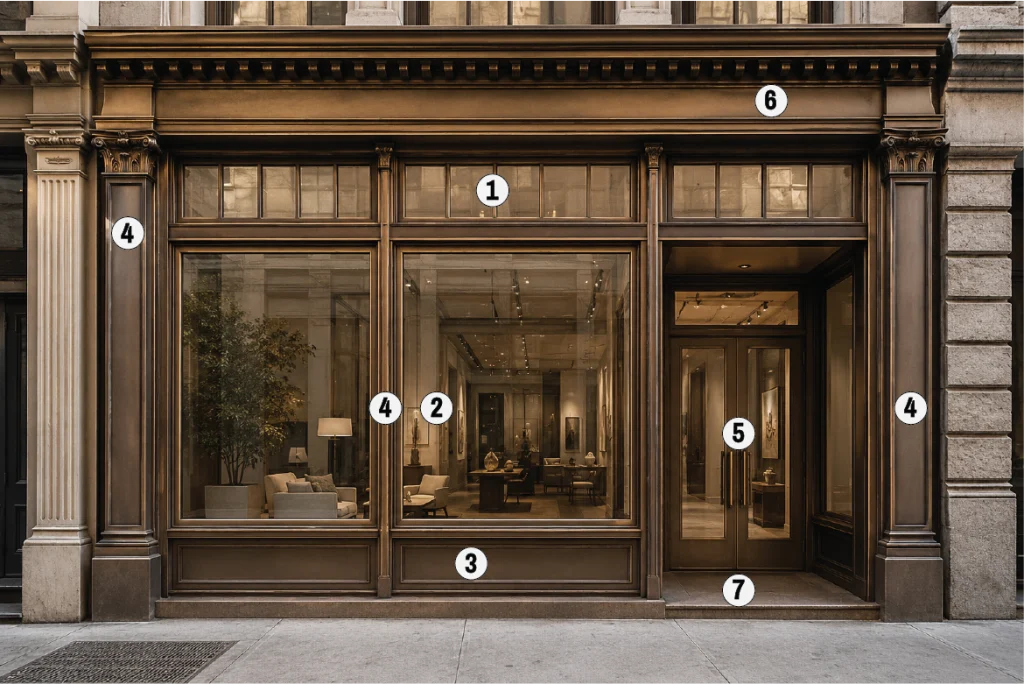
The Elements of a Historic NYC Storefront

elements of historic NYC storefront
  1. Transom — The glazed section above the main display window, between the top of the storefront frame and the base of the upper floor win dows. In cast iron buildings, transoms are often divided by thin mullions and contribute significantly to the facade’s rhythm. The LPC frequently requires transoms to be retained or replicated.
  2. Display window — The primary large glazed opening at street level. Proportions — height, width, and the relationship to the structural piers or pilasters on either side — are the defining element of the storefront’s character and the LPC’s primary focus in review.
  3. Bulkhead — The solid panel below the display window, between the sill and the sidewalk level. In historic storefronts, bulkheads were typically wood, marble, cast iron, or tile. The LPC requires bulkheads to be in a material and finish compatible with the historic character.
  4. Pilasters — The vertical structural or decorative elements on either side of the storefront opening, often cast iron in SoHo buildings. Pilasters define the width of the storefront bay and must be preserved or accurately replicated.
  5. Entrance door and surround — The door position, width, andå surround details are part of the storefront’s historic composition. Relocating an entrance or changing its proportions requires LPC review and is not always approved.
  6. Cornice and fascia — The decorative horizontal element at the top of the storefront, between the ground-floor facade and the upper floors. Often includes signage band. LPC guideålines govern materials and profile.
  7. Recessed or flush entry — Whether the entrance door is set back from the facade plane or flush with it is a historically significant feature that the LPC evaluates in storefront submissions.

Who We Work With on Commercial Storefront Projects

Property owners and landlords

Replacing deteriorated original storefronts

LPC compliance for building sale or refinancing

Coordinating with retail tenant buildout

Long-term durability and low maintenance

Need: clear process, documentation, single contact

Commercial architects

Specifying storefront systems for tenant fit-out

LPC submission preparation

Profile matching to existing building fabric

CAD/shop drawings for permit set

Need: technical specs, fast response, samples

Retail tenants and hospitality

Customizing storefront as part of brand buildout

LPC approval required before fit-out begins

Coordination with landlord and architect

Brand color and finish requirements

Need: timeline certainty, design flexibility
Who We Work With on Commercial Storefront Projects

  1. Site review and historic assessment — We review the building’s designation status, original storefront construction, and any prior LPC approvals. For SoHo and Greenwich Village buildings, we assess which elements must be preserved or replicated and which permit flexibility in material or configuration.
  2. System recommendation — We recommend the storefront system — steel, bronze, or aluminum — that best matches the building’s original facade character and is most likely to receive LPC approval. We provide profile samples and finish samples for review with the design team.
  3. Shop drawings and LPC documentation — We prepare full shop drawings showing storefront elevations, profile cross-sections, transom and bulkhead details, en-trance door configuration, and anchoring to the existing structure. Documentation is prepared in the format required for LPC submission.
  4. LPC submission coordination — We work with the project architect or expediter to prepare and file the submission package. For commercial storefronts in SoHo and Greenwich Village, we are familiar with the LPC staff who handle these districts and the level of documentation they require.
  5. Fabrication — Lead times for commercial storefront systems: steel 14–20 weeks, aluminum 8–12 weeks, bronze 16–24 weeks. We provide production updates and coordinate fabrication scheduling with the project timeline.
  6. Delivery and installation coordination — We coordinate delivery with the general contractor and provide installation guidance. For complex storefront installations involving existing cast iron elements, we coordinate closely with the GC on anchoring and integration details.

Selected Commercial Storefront Projects

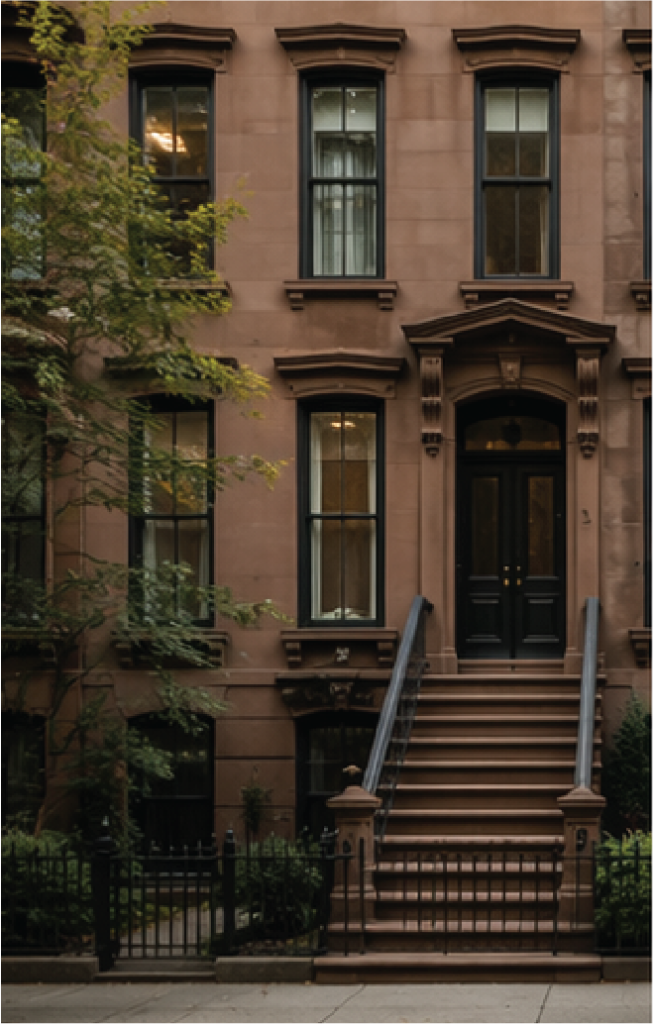
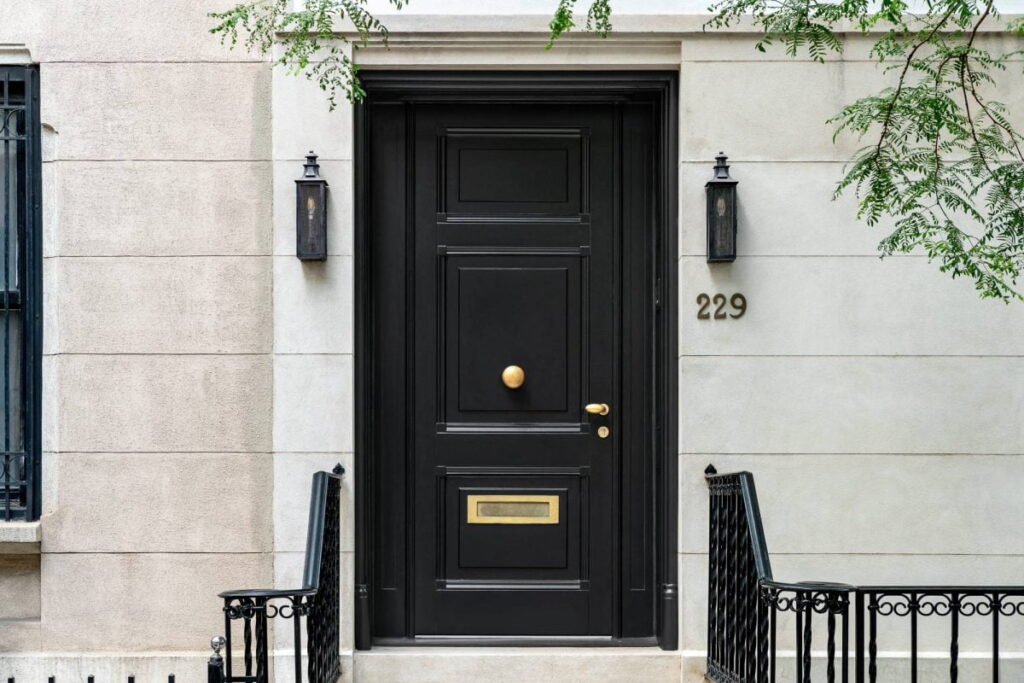
brownstone rowhouse
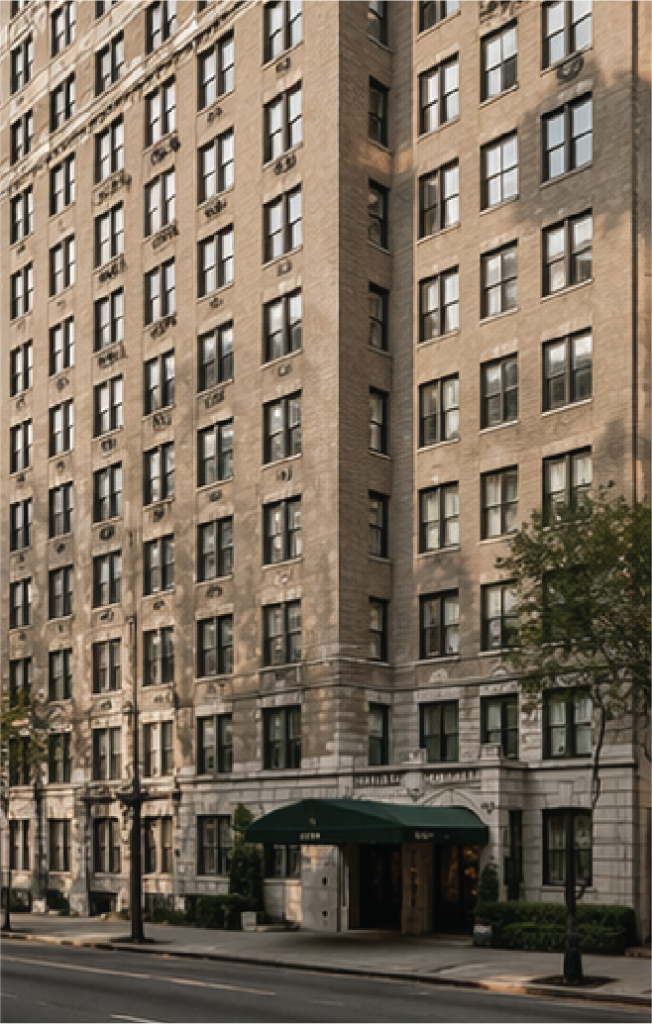
Pre-war co-op or apartment building

Location — SoHo Cast Iron building, Greene Street

Landmark district

System — Custom steel storefront with matching transom”

Challenge — Replicating original cast iron profile geometry in steel

LPC — тип approval і timeline Result —
Location — SoHo Cast Iron building, Greene Street

Landmark district

System — Custom steel storefront with matching transom”

Challenge — Replicating original cast iron profile geometry in steel

LPC — тип approval і timeline Result —
FAQ Questions

What LPC approval do I need to replace a storefront in SoHo?
Replacing a storefront in the SoHo–Cast Iron Historic District requires a Certificate of Appropriateness from the Landmarks Preservation Commission, issued after a public hearing before the full commission. Unlike straightforward residential window replacements — which can often be handled through a faster staff-level Certificate of No Effect — commercial storefront alterations in SoHo are considered significant interventions in one of NYC’s most regulated historic districts, and they consistently require the full Certificate of Appropriateness process.

The LPC’s guidelines for SoHo storefronts are detailed and specific. The commission evaluates the proposed system’s profile geometry against the original cast iron storefront — including the transom configuration, the proportions of the display window, the treatment of the bulkhead, the position and width of the entrance door, and the material and finish of all visible components. Steel and bronze are the materials most consistently approved for SoHo storefront replacements because they can be fabricated to closely replicate the slim profiles of the original cast iron elements. Standard commercial aluminum curtain wall systems with wide frame extrusions are generally not approved.

The timeline for a Certificate of Appropriateness in SoHo typically ranges from three to six months from a complete submission to a commission decision, depending on the complexity of the project and the current commission calendar. A thorough and well-documented submission — including detailed shop drawings, material samples, historic photographs, and a written description of how the proposed design relates to the building’s original storefront — reduces the risk of revision requests and additional hearings. Open AWD prepares complete technical documentation for SoHo storefront submissions as part of our standard commercial project process.
Can a retail tenant apply for LPC storefront approval, or must it be the building owner?
A retail tenant can apply for LPC approval for storefront alterations, but the application must include written authorization from the building owner, and in practice the building owner’s involvement and consent is essential throughout the process. The LPC requires an owner authorization letter as part of the submission package for any Certificate of Appropriateness application, confirming that the property owner supports the proposed work. Without this letter, the application will not be accepted for review.

In a typical commercial lease situation, the sequence is: the tenant identifies the storefront changes they want to make as part of their fit-out, their architect designs the storefront in a way that is intended to satisfy LPC requirements, the building owner reviews and authorizes the application, and the tenant’s team files the submission. The LPC approval is associated with the building address rather than the tenant, which means the approved storefront configuration becomes the landlord’s responsibility to maintain after the tenancy ends.

For retail tenants in SoHo, Greenwich Village, or other landmark commercial districts, it is important to understand that LPC approval must be obtained before any physical work begins on the storefront — not after. Beginning storefront construction without approval is a violation of the Landmarks Law and can result in stop-work orders, fines, and a requirement to restore the original conditions. The LPC approval process should be factored into the fit-out timeline from the start of lease negotiations, as it typically adds three to six months to the timeline before physical work can begin. Open AWD works with both tenants and their architects to develop storefront designs that are commercially viable and LPC-approvable, and we can advise on the likely approval path before significant design investment is made.
What materials does the LPC accept for storefront replacement in the SoHo Cast Iron District?
The LPC’s SoHo–Cast Iron Historic District Guidelines specify that storefront replacements should use materials that are visually compatible with the original cast iron construction of the building. In practice, the materials most consistently approved for SoHo storefront replacements are steel, bronze, and — in some cases — slim-profile thermally broken aluminum.

Steel is the most appropriate material for SoHo storefront systems because it can be fabricated into profiles with face widths as narrow as 1 inch, closely replicating the slim sightlines of original cast iron storefront elements. Hot-rolled steel systems with custom profiles have a strong approval precedent in the SoHo district and are the LPC’s preferred material for buildings where the original storefront was cast iron or early steel. Bronze is historically appropriate for buildings with original bronze elements — particularly entrance door surrounds and hardware — and is also well-accepted by the commission for high-end storefront restorations.

Aluminum is accepted in the SoHo district in certain circumstances, specifically when the profile geometry is slim enough to be visually compatible with the building’s original storefront proportions and when the finish color is appropriate to the historic palette. Standard commercial aluminum curtain wall extrusions — with face widths of 2.5 inches or more — are generally not approved in SoHo because they are visually inconsistent with the slim profiles of the original cast iron construction. Vinyl, fiberglass, and standard-profile commercial aluminum are not accepted in the SoHo Cast Iron Historic District. Open AWD can confirm which material and profile is most appropriate for your specific building before any design investment is made.
Can I change the storefront configuration — move the entrance door or add a new opening?
Changes to storefront configuration — including relocating the entrance door, widening or narrowing the display window, adding or removing a transom, or creating a new opening in the facade — all require LPC approval and are evaluated on a case-by-case basis. The commission’s approach to configuration changes is more conservative than its approach to like-for-like material replacements: the LPC will approve configuration changes only if they are consistent with the building’s original design intent or with the typical storefront arrangement for buildings of that type and era in the district.

Relocating an entrance door is the most commonly requested configuration change, and the outcome depends heavily on the specific building and district. In some cases, the original entrance position is clearly documented in historic photographs or the building’s designation report, and the LPC will require that it be maintained. In other cases, the original position is unknown or the building has already undergone multiple alterations, and the commission may be open to a configuration that improves accessibility or commercial function while remaining visually compatible with the building’s character.

Adding a new opening — for example, creating a second entrance or enlarging a display window — is a more significant alteration and requires a strong justification in the submission. The LPC is generally reluctant to approve new openings in load-bearing masonry facades because they alter the rhythm and proportion of the building’s street-level expression. The most reliable way to assess whether a proposed configuration change is approvable is to consult with an expediter or preservation architect familiar with the relevant district, and to review precedent decisions for similar buildings. Open AWD can provide input on the technical feasibility and likely LPC reception of proposed configuration changes based on our experience with storefront projects in SoHo and Greenwich Village.
What is the difference between a storefront replacement and a storefront restoration?
A storefront replacement involves removing the existing storefront system — which may or may not be original — and installing a new system in its place. The new system may use different materials, updated profiles, or improved thermal performance, but its visual character must be compatible with the building’s historic facade. Storefront replacements are common when existing storefronts are severely deteriorated, have been previously altered with non-historic materials, or need to be upgraded to meet current energy and accessibility requirements.

A storefront restoration involves repairing, stabilizing, or returning an existing historic storefront to its original condition or appearance, using the same materials and methods as the original construction where possible. Restoration is the approach the LPC most strongly encourages when original historic fabric is intact or partially intact — the commission’s preservation philosophy prioritizes retaining original material over replacing it, even when replacement would be easier or less expensive.

In practice, many commercial storefront projects in SoHo and Greenwich Village involve elements of both: original cast iron pilasters and cornices are retained and restored, while the glazed infill — display windows, transoms, entrance door — is replaced with a new system that matches the original profile geometry in a contemporary material. This hybrid approach allows the building to retain its most significant historic elements while achieving modern performance in the glazed components.
Do commercial storefronts in landmark districts need to meet NYC energy code?
Yes. Commercial storefronts in New York City landmark districts are subject to the New York City Energy Conservation Code (NYCECC), which sets minimum thermal performance requirements for building envelopes including glazed storefronts. The energy code applies regardless of landmark status — a building’s designation as a landmark does not exempt it from energy requirements.

For commercial storefronts, the relevant requirements are primarily the maximum U-factor for fenestration and the Solar Heat Gain Coefficient (SHGC). The NYC energy code includes a specific provision for historic buildings that acknowledges the tension between energy compliance and preservation requirements. Where full compliance would require changes that the LPC would not approve, alternative compliance paths are available — including compensating measures elsewhere in the building envelope, or the use of high-performance glazing within a historically compatible frame.

In practice, thermally broken steel and aluminum storefront systems with double or triple IGU glazing can meet NYC energy code requirements while maintaining the slim visible profiles required for LPC approval in SoHo and other historic commercial districts. Open AWD specifies all storefront systems with thermal performance data and can confirm code compliance for specific configurations as part of the design process.
How long does LPC approval take for a commercial storefront in NYC?
LPC approval for a commercial storefront replacement in a New York City historic district typically takes longer than residential window approvals and should be planned for accordingly. For most commercial storefront projects — particularly in SoHo and Greenwich Village where a Certificate of Appropriateness and public hearing are required — the realistic timeline from a complete submission to a commission decision is three to six months.

This timeline breaks down as follows: after a complete submission is filed, the LPC staff reviews the package and schedules the project for a public hearing before the full commission. Hearings are held approximately monthly, and the scheduling depends on when in the commission’s calendar the submission is complete and how many projects are ahead in the queue. If the commission requests revisions, the project must return for a second hearing, adding one to three months to the timeline.

For retail tenants planning a fit-out, the total time from beginning the LPC process to receiving approval and being able to start physical work should be budgeted at six to nine months in a typical SoHo or Greenwich Village storefront project. Open AWD advises all commercial clients to begin the LPC process as early as possible — ideally at the lease signing stage rather than after tenant improvements have been designed.
Can I use a brand-specific color on a historic storefront in NYC?
In some cases, yes — but with important constraints, and the outcome depends heavily on the specific brand color, the building’s historic district, and how the color is applied. The LPC evaluates storefront finish colors on the basis of visual compatibility with the building’s historic character, not on the basis of brand identity. A brand color that falls within the range of historically appropriate colors for the district — dark greens, blacks, deep reds, bronze tones, off-whites — has a reasonable chance of approval. A brand color that has no precedent in the building’s historic palette — bright oranges, corporate blues, high-visibility yellows — will almost certainly not be approved for the primary storefront frame and display window elements.

The distinction the LPC typically draws is between the storefront system itself — the frame, the door, the transom — and the signage and applied graphics. The commission has jurisdiction over the painted or powder-coated color of the storefront frame and door, but signage is reviewed under a separate process. Retail brands that operate in historic districts typically achieve their brand presence through signage, lighting, and interior visual merchandising rather than through a brand-colored storefront frame.

Well-known retail and hospitality tenants operating in SoHo and Greenwich Village have navigated this successfully by working with the LPC’s color requirements at the frame level — specifying a historically appropriate dark color for the storefront system — while maintaining brand identity through other means. The key is to bring the color question to the LPC early in the design process, before the storefront system is specified, rather than after the brand design team has committed to a color that may not be approvable. Open AWD works with retail architects and tenant design teams on storefront specifications that meet both LPC requirements and the client’s commercial design objectives.

Working on a Historic Commercial Storefront in NYC?

Tell us your building address and what you need to replace or restore. We'll confirm LPC requirements and recommend the right system.

Request a technical briefing or spec sheet. We provide shop drawings, profile samples, and LPC documentation as part of our standard commercial project process.

If you're planning a storefront as part of a new lease or fit-out, we can advise on what LPC will and won't approve — and how to work within those constraints to achieve your brand's design intent.
Call Now