LPC Window Approval in NYC — Systems, Documentation, and Expert Guidance

Limited-time 10% discount
on your first project

Trusted local window experts serving you since 2008
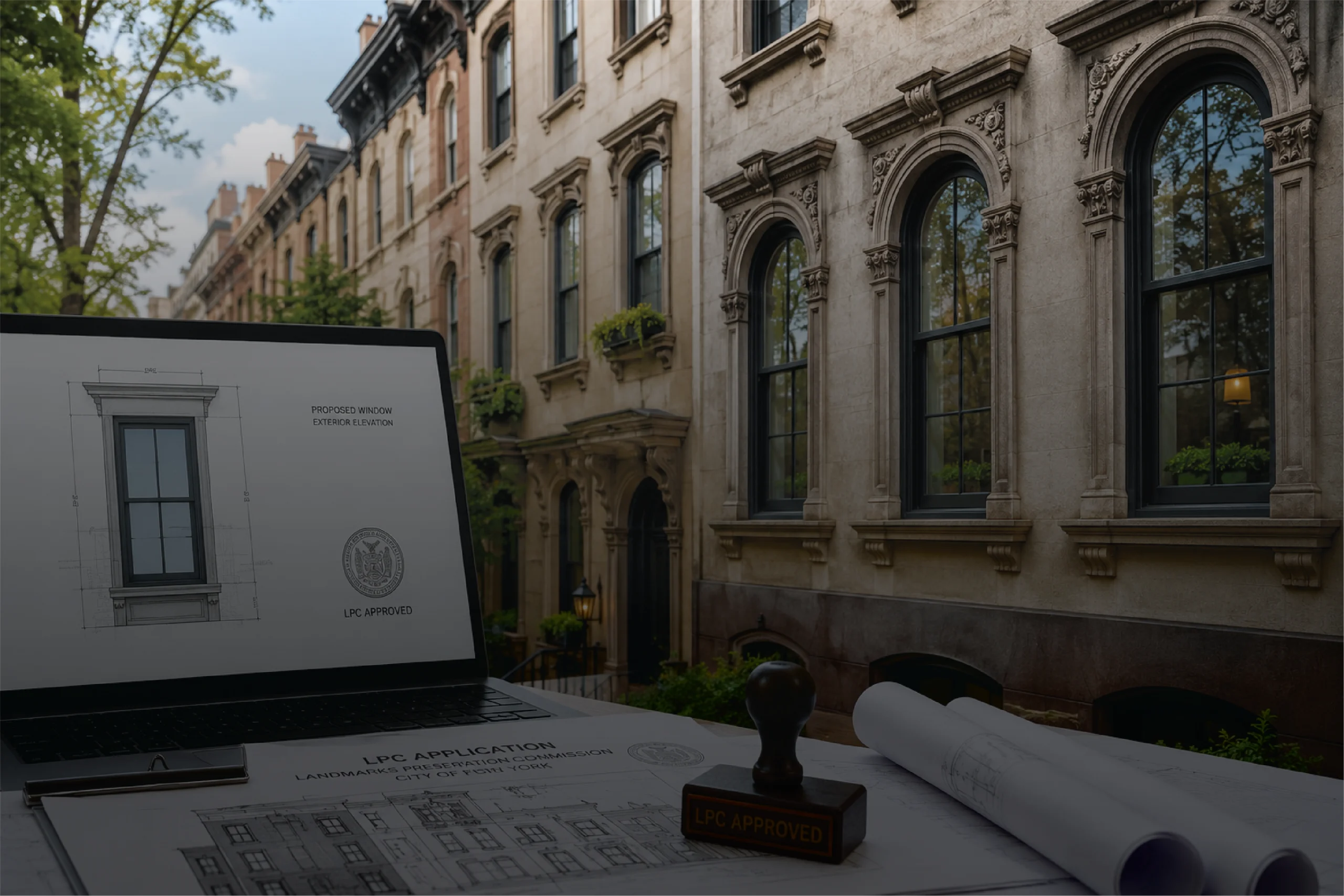
Getting window replacement approved by the New York City Landmarks Preservation Commission requires more than choosing the right window — it requires the right documentation, the right shop drawings, and a supplier who understands what the LPC looks for. Open AWD has been supplying LPC-compatible window systems and preparing technical submissions for landmark buildings across Manhattan and Brooklyn since 2008. We know what passes review, and we know how to document it.
- LPC submissions prepared since 2008
- Shop drawings and material documentation included
- Wood · Steel · Aluminum · Bronze — all LPC-compatible systems
- Free landmark status verification for all clients

Limited-time 10% discount
on your first project

Trusted local window experts serving you since 2008

Two Types of LPC Review — Which One Applies to Your Project?

Staff-Level Approval

Reviewed by LPC staff — no public hearing

Timeline: 2–4 weeks typically

Applies when: like-for-like replacement, same material, LPC-compatible profile

Most common for: straightforward brownstone window replacement

Required docs: application, photos, shop drawings, material spec

Lower risk of revision requests if submission is complete

Certificate of Appropriateness (Public Hearing)

Reviewed by full LPC commission — public hearing required

Timeline: 2–4 months typically

Applies when: material change, configuration change, new openings

Most common for: changing from wood to steel, altering window size

Required docs: full package + written scope + owner letter

Outcome less predictable — quality of submission matters more

What the LPC Evaluates When Reviewing Window Replacements

Material — Does the replacement material match or relate to the original? Wood for wood, steel for steel — like-for-like is almost always approved. Material changes require more justification.

Profile and sightline width — The visible face width of the frame must match the original as closely as possible. A wider frame than the original will typically be rejected on first review.

Muntin configuration — The number, size, and pattern of muntins must replicate the original window’s divided-light pattern if one exists. TDL is preferred; SDL is accepted with proper shadow-line depth.

Glass type — Reflective or heavily tinted glass is rarely approved on street-facing facades. Clear or low-iron glass with standard low-e coating is the safe specification.

Finish color — Must be compatible with the building’s historic palette. Dark colors, off-whites, and period-appropriate greens and browns are generally accepted. Bright or non-historic colors are not.

Visibility from street — LPC jurisdiction applies to windows visible from a street, sidewalk, or public space. Rear windows not visible from the street often fall outside LPC review — confirm with your expediter.

Completeness of submission — An incomplete package is the single most common cause of delays. Missing shop drawings, unclear photos, or an unsigned application form can add weeks to the process.
LPC Window Replacement Submission — What You Need to Prepare

✓ Completed LPC application form (available at nyc.gov/landmarks)

✓ Photographs of existing windows — close-up of profile, full facade view, street-level view

✓ Shop drawings showing: profile dimensions, sightline widths, muntin configuration, frame depth, anchoring method

✓ Material specification: frame material, finish color (RAL or paint reference), glazing type

✓ Physical sample or sample board (required for some reviews, recommended for all)

✓ Building address and tax lot number

✓ Owner authorization letter (required for Certificate of Appropriateness)

✓ Architect’s stamp (required for some project types — confirm with expediter)

✓ Existing window dimensions — width, height, rough opening size

✓ Confirmation of landmark status — individual landmark or historic district
Download our full LPC submission checklist as a PDF, or contact us to discuss your specific project.

Open AWD prepares shop drawings and material documentation as part of our standard process for all landmark projects — at no additional charge.

NYC Historic Districts — Where LPC Approval Is Required

New York City has over 150 designated historic districts across the five boroughs, covering tens of thousands of individual buildings. If your building is within one of these districts, LPC approval is required for any window replacement visible from a public way — regardless of building type, ownership structure, or whether the windows are being replaced like-for-like.

Brooklyn Heights Historic DistrictOne of NYC’s first designated districts; predominantly Federal and Greek Revival rowhouses with wood double-hung windows
Park Slope Historic DistrictVictorian and Romanesque Revival brownstones; wood double-hung and bay windows predominant
Carroll Gardens / Cobble HillItalianate and Greek Revival rowhouses; similar window profiles to Park Slope
Boerum Hill Historic DistrictMixed rowhouse stock; wood and some original steel casements
Fort Greene / Clinton HillLate Victorian brownstones and some early twentieth century buildings
Prospect Heights Historic DistrictBrownstones and limestone rowhouses; LPC review active
Crown Heights North Historic DistrictsEarly twentieth century rowhouses and apartment buildings
West Chelsea Historic DistrictIndustrial loft buildings, steel casements predominant
Greenwich Village / West VillageFederal and Greek Revival rowhouses, wood windows
SoHo–Cast Iron Historic DistrictCast iron facades, large windows, LPC review complex
Upper West Side / Upper East Side Historic DistrictsPre-war apartment buildings and townhouses
Harlem Historic DistrictsRowhouses and tenement buildings, growing renovation activity

How Open AWD Supports Your LPC Submission

  1. Landmark status verification — We confirm whether your building requires LPC review, which type of review applies, and whether any prior approvals exist for window replacement in your district. Free for all clients.
  2. System recommendation — We recommend the window system most likely to pass LPC review for your building type and district — based on the original window material, the district’s precedent, and the commission’s current review priorities.
  3. Shop drawings — We prepare detailed technical drawings showing profile dimensions, sightline widths, muntin configuration, glass specification, and anchoring details — in the format the LPC requires. Included as standard in our landmark project process.
  4. Material documentation — We provide written material specifications, finish color references, and glazing data sheets for inclusion in your submission package. Physical samples can be provided for the commission review if required.
  5. Submission coordination — We work directly with your expediter or architect to ensure the technical components of the submission package are complete and correctly formatted before filing. We are available to answer technical questions from the LPC during the review period.
  6. Revision support — If the LPC requests revisions to the shop drawings or material specification, we prepare revised documentation promptly. Our experience with the commission’s requirements means revision requests are uncommon when we prepare the submission package.
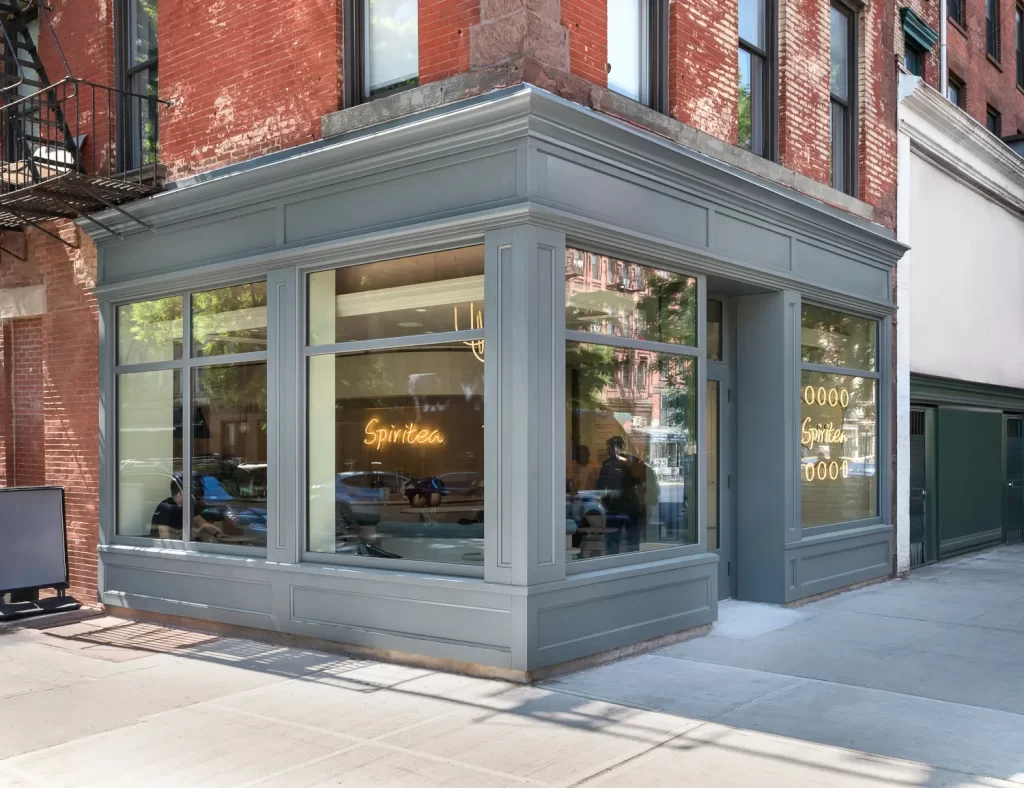
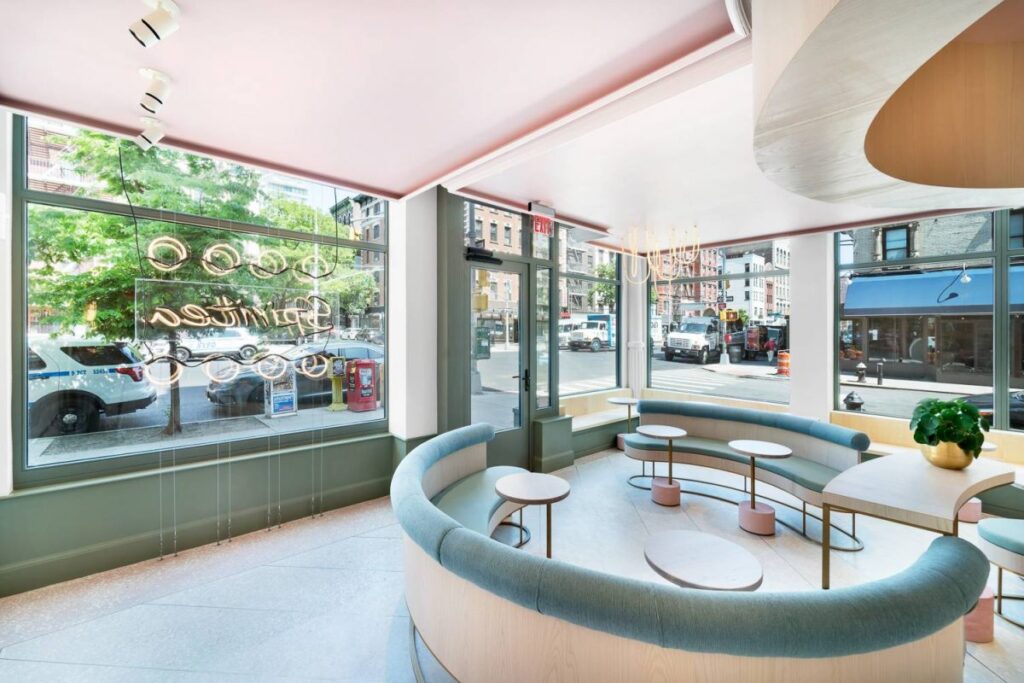
A sophisticated, slate-blue storefront with elegant recessed paneling and classic crown molding features expansive glass windows that reflect a bustling city street with historic red brick buildings, while a central, glass-paned door provides a glimpse into the contemporary, light-filled interior of the Spiritea tea shop, whose name is illuminated in a warm amber neon sign within the minimalist, lounge-like space.

FAQ Questions

What is the difference between a Certificate of No Effect and a Certificate of Appropriateness?
A Certificate of No Effect (CNE) and a Certificate of Appropriateness (CofA) are the two primary LPC approvals required for exterior alterations to landmarked buildings in New York City, and they differ significantly in scope, timeline, and process.

A Certificate of No Effect is issued by LPC staff without a public hearing. It applies to work that does not affect the significant architectural features of the building – in window terms, this typically means a straightforward like-for-like replacement using a compatible material, profile, and color. Because the review is handled administratively by staff, the timeline is shorter: two to four weeks for a complete, well-documented submission. This is the approval path for the majority of residential window replacement projects in NYC historic districts where the homeowner is replacing in-kind.

A Certificate of Appropriateness requires a public hearing before the full LPC commission and is required for work that involves a change in material, a change in window configuration, new openings, or any alteration that the commission determines could affect the building’s significant architectural features. The timeline is considerably longer — typically two to four months from submission to decision, depending on the commission calendar and the complexity of the project. The outcome is also less predictable, since it involves a commission vote rather than a staff determination.

For most brownstone and rowhouse window replacement projects in Brooklyn and Manhattan, a CNE is the applicable approval — provided the replacement window closely matches the original in material, profile, and configuration. Open AWD can advise which approval type applies to your specific project based on your building address, landmark district, and the scope of the replacement work.
Can I replace my windows without telling the LPC if I'm in a landmark district?
No. If your building is within a New York City Historic District or is individually landmarked, you are legally required to obtain LPC approval before replacing any windows or doors that are visible from a public way — regardless of whether the replacement appears identical to the original, and regardless of whether you own the building outright. Proceeding without approval is a violation of the New York City Administrative Code, specifically the Landmarks Law.

The LPC has enforcement staff who conduct field inspections and respond to complaints from neighbors and community members. Unpermitted window replacements are a common enforcement target in Brooklyn and Manhattan historic districts, particularly in neighborhoods where renovation activity is high. The LPC also has access to permit records and can identify buildings where construction activity has occurred without corresponding landmark approvals.

If you are considering replacing windows without LPC approval because the process seems time-consuming or uncertain, it is worth knowing that the majority of straightforward brownstone window replacements — same material, compatible profile, matching configuration — are approved at the staff level in two to four weeks with a complete submission package. The process is more manageable than many homeowners expect, particularly with a supplier who prepares the technical documentation as part of the project. Open AWD prepares shop drawings and material specifications for all landmark projects as standard, which is the most common point of friction for homeowners attempting to navigate the process independently.
What happens if I replace windows without LPC approval in NYC?
Replacing windows without LPC approval in a designated historic district or individually landmarked building is a violation of the New York City Landmarks Law and carries real consequences. The LPC has authority to issue a Notice of Violation, which requires the property owner to either obtain retroactive approval for the work that was done or restore the building to its prior condition — at the owner’s expense.

In cases where the replacement windows are not compatible with the building’s historic character and retroactive approval is not possible, the LPC can require the owner to remove the non-compliant windows and reinstall historically appropriate replacements. This is the worst-case outcome: the owner has paid for one set of windows, is required to remove them, and must pay for a second replacement that meets LPC requirements. The cost of restoration can significantly exceed the original cost of the unpermitted work.

In addition to restoration requirements, the LPC can impose civil penalties. For individual building owners, these are typically in the range of several hundred to several thousand dollars per violation, depending on the severity and whether the violation is corrected promptly. Persistent non-compliance can result in escalating penalties and referral to the New York City Corporation Counsel for legal action.

From a practical standpoint, unpermitted work can also complicate the sale of a property. Title searches and co-op board reviews often reveal open LPC violations, which must be resolved before a transaction can close. Open AWD recommends obtaining LPC approval before any window replacement work in a landmarked building — the process is manageable, and the alternative risks are not worth taking.
How do I find out what type of windows my building originally had?
There are several reliable ways to determine what windows your building originally had, and in most cases a combination of two or three sources will give you a clear answer. The most useful starting point is the LPC’s own designation report for your historic district or individual building, which is publicly available on the LPC website at nyc.gov/landmarks. Designation reports typically describe the significant architectural features of the buildings in the district, including window types, materials, and profile characteristics that were original to the buildings at the time of designation.

Historic photographs are the most direct evidence of original window appearance. The New York Public Library’s digital collections, the Museum of the City of New York’s photo archive, and the NYC Department of Records’ Municipal Archives all hold extensive photographic records of NYC streetscapes dating back to the late nineteenth and early twentieth centuries. A search by street address or block often yields photographs showing the original windows clearly.

Physical evidence on the building itself is also informative. If original windows survive on less-visible elevations — the rear facade, upper floors, or interior-facing windows in a row of attached buildings — they provide direct information about the original profile, material, and muntin pattern. Traces of original hardware, weight pockets in the wall, or original sill and jamb dimensions can also provide useful data even when the original sashes are gone.

For buildings in designated historic districts, the LPC’s staff can sometimes provide guidance on what window types are typical for buildings of that era and style in that district. Open AWD also reviews building history and original window characteristics as part of our standard consultation process for landmark projects — bring your building address and any historic photographs you have found, and we will advise on the most appropriate replacement specification.
Can my window supplier prepare the LPC shop drawings?
Yes — and for most residential window replacement projects in NYC historic districts, having the window supplier prepare the shop drawings is the most efficient and reliable approach. Shop drawings prepared by the supplier show the exact profile dimensions, sightline widths, muntin configuration, glazing specification, and anchoring details of the actual system being supplied — which is precisely the information the LPC needs to evaluate the submission. Drawings prepared by a third party who is not familiar with the specific system being supplied are more likely to contain inaccuracies that generate revision requests from the commission.

Not all window suppliers prepare LPC-format shop drawings as part of their standard process, however. Many suppliers provide generic product drawings or catalog sheets that are not formatted for LPC submission and do not include the specific information the commission requires. Before selecting a supplier for a landmark project, it is worth confirming explicitly that they will provide shop drawings in a format suitable for LPC submission, and that this is included in the project scope rather than treated as an additional service.

Open AWD prepares LPC-format shop drawings for all landmark projects as standard — at no additional charge. Our drawings include all information required for a complete submission: profile cross-sections with dimensions, elevation views showing the full window in the opening, muntin configuration details, glazing specification, finish color reference, and anchoring method. We have prepared shop drawings for LPC submissions across multiple historic districts in Brooklyn and Manhattan, and we are familiar with the level of detail and formatting that the commission’s staff expects.
Does the LPC approve specific window brands or manufacturers?
No. The LPC does not maintain a list of approved window brands or manufacturers, and it does not pre-approve specific products. The commission evaluates each submission on its own merits — based on whether the proposed window’s visual characteristics are compatible with the building’s historic character — without reference to brand or manufacturer. A window from a manufacturer the commission has never encountered can be approved on first submission if the profile, material, and configuration are appropriate. A window from a well-known manufacturer can be rejected if the sightlines are too wide or the muntin pattern is incorrect.

This means that the quality of the submission documentation matters as much as the quality of the window. A correctly specified window presented in a clear, complete shop drawing set is more likely to receive a straightforward staff-level approval than the same window presented in a poorly formatted or incomplete submission. The LPC staff are reviewing dozens of submissions simultaneously, and a submission that clearly demonstrates compatibility — with accurate profile dimensions, clear photographs of the existing conditions, and a well-described material specification — moves through review more efficiently.

What the LPC does recognize over time is precedent: if a particular profile or system has been approved for similar buildings in the same district in previous submissions, that precedent can support a new submission using the same or similar system. Open AWD’s experience with multiple submissions across NYC historic districts means we are aware of which systems have established positive precedent in which districts, and we factor this into our system recommendations for landmark projects.
What is the most common reason LPC window submissions are rejected?
The most common reasons LPC window submissions result in revision requests or outright rejection fall into three categories: incompatible profile dimensions, incomplete documentation, and incorrect or non-historic finish specifications.

Incompatible profile dimensions — specifically, frame profiles and sightlines that are wider than the original windows — is the most frequent substantive reason for rejection. Standard replacement windows from mass-market manufacturers are almost universally too wide in their frame profiles to pass LPC review for pre-war brownstones and rowhouses. A face width of three or four inches reads immediately as a modern replacement and is inconsistent with the slim profiles of original wood or steel windows. The LPC will typically ask for a revised submission showing a slimmer profile or, in some cases, reject the submission outright and require a different system.

Incomplete documentation is the most common procedural reason for delay, if not outright rejection. Missing shop drawings, photographs that do not clearly show the existing window profile, an unsigned application form, or a material specification that does not identify the finish color by reference number are all common deficiencies that trigger a request for additional information and add weeks to the review timeline.

Incorrect finish specifications — particularly reflective glass on a street-facing facade, or a frame color that has no precedent in the building’s historic palette — are also a recurring issue. The LPC is particularly sensitive to glass reflectivity on historic facades, as highly reflective glass changes the visual character of the building in a way that is immediately apparent from the street. Standard clear or low-e glass is almost always acceptable; specifying the glass type explicitly in the submission prevents this from becoming a revision issue. Open AWD reviews all of these elements before a submission is filed and prepares documentation specifically to avoid the most common causes of delay and rejection.
Can I appeal an LPC decision on a window replacement?
Yes, LPC decisions can be appealed, though the process and the realistic prospects of a successful appeal depend significantly on the type of decision and the grounds for appeal. For decisions made at the staff level — a Certificate of No Effect denial, for example — the first step is typically to request a reconsideration or to resubmit with revised documentation that addresses the specific concerns the staff identified. This is not a formal appeal but an administrative resubmission, and it is the most common and most efficient path to resolution when a submission has been rejected for correctable reasons such as an incompatible profile or incomplete drawings.

For decisions made by the full commission — a Certificate of Appropriateness denial after a public hearing — a formal appeal can be filed with the New York City Board of Standards and Appeals (BSA). The BSA can review LPC decisions on the grounds that the commission acted in excess of its jurisdiction, made an error of law, or that the denial constitutes an undue hardship on the property owner. BSA appeals are a more formal legal process and typically require representation by an attorney or a preservation consultant with experience in landmark law. The timeline for a BSA appeal is several months to over a year, and the success rate for overturning a full commission denial is relatively low.

In practice, most landmark window replacement disputes are resolved before reaching the formal appeal stage. If a submission is denied or results in significant revision requests, the most practical path is usually to revise the window specification to address the commission’s concerns — adjusting the profile, changing the material, or modifying the muntin configuration — and resubmit. Open AWD has not had a final denial on a window submission where we prepared the full documentation package, though we have worked through revision requests on complex projects involving material changes or non-standard configurations. We recommend contacting us before pursuing a formal appeal, as a revised specification approach is almost always faster and more reliable.

Need Help Getting Your Windows Through LPC Review?

Tell us your building address and what you're planning to replace. We'll confirm your landmark status, recommend the right system, and outline what documentation we can prepare for your submission — at no charge and with no obligation.
Call Now